
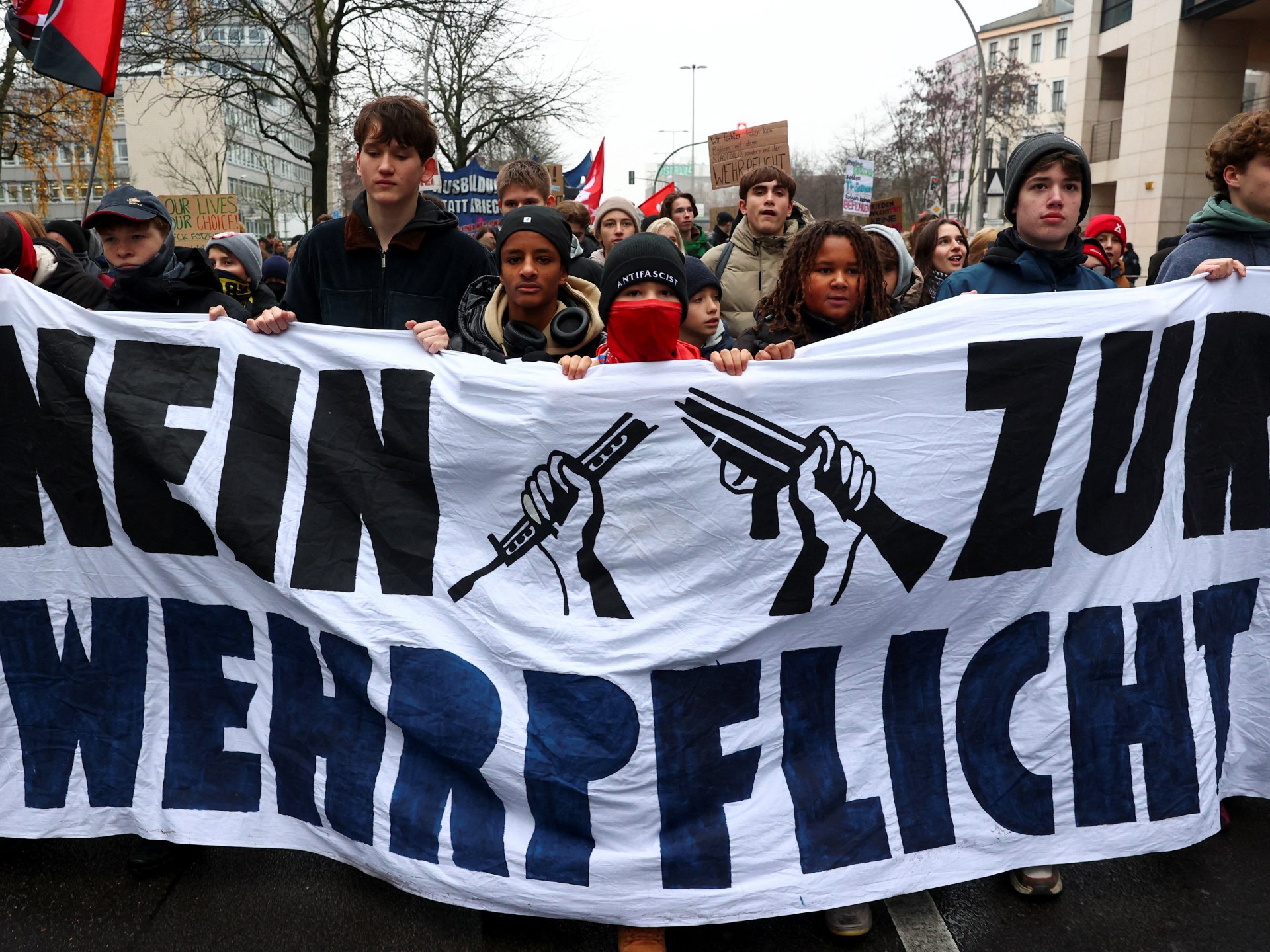
Politicians approve the controversial conscription law after months of heated debate, amid fears over a potential war with Russia.
About 3,000 people have taken to the streets of Berlin to protest against Germany’s new military service bill, after Bundestag politicians backed the legislation intended to bolster the country’s armed forces.
Germany’s parliament approved the controversial conscription legislation on Friday after months of heated debate. It comes amid a pledge by NATO allies to increase defence spending, boosting Europe’s defence capabilities amid fears Russia’s war on Ukraine could spill across its borders.
Recommended Stories
list of 3 itemsend of list
Tess Datzer, an 18-year-old protester in the German capital, said she felt it was unfair for her generation to have to go to war “for a country that does little for us”.
“There is no investment in our pensions, not in our future, not in the climate. I don’t see any good reasons why our generation should have to go to war,” she told the AFP news agency.
Protest organiser Ronja Ruh said an “unbelievable amount of money is being spent on the military and armament” in Germany, while funds are lacking in basic public services.
“When we look at schools in particular, there is outdated technology, far too few teachers, dilapidated school buildings,” she said.
The military service bill sets ambitious expansion goals for the Bundeswehr, as Germany’s armed forces are known, with a target of up to 260,000 active soldiers – up from 183,000 currently – and 200,000 reservists by 2035.
It introduces a dual-track system to boost recruits: a more lucrative voluntary service intended to attract young recruits, but if enlistment falls short, lawmakers can now activate needs-based conscription.
To do so, the politicians would be required to hold a Bundestag vote. If more people are eligible for conscription than needed, recruits may be randomly selected.
All men born after January 1, 2008, will undergo medical evaluation, in a move not seen since Germany suspended conscription in 2011. Both 18-year-old men and women will be asked to declare their willingness to serve, though only men must respond.
Countries across Europe – including France, Italy and Belgium, as well as the Nordic and Baltic states – are moving to expand voluntary service and strengthen mandatory conscription in their armed forces in response to Russian provocation.
European leaders and intelligence services believe Russia could mount an assault elsewhere on the continent, with Germany’s top military official, Carsten Breuer, saying in 2024 that Moscow could be ready to attack NATO countries in five to eight years’ time.
In late November, announcing the reintroduction of a limited form of military service in France 25 years after conscription was formally ended, President Emmanuel Macron said, “the only way to avoid danger is to prepare for it”.
“We need to mobilise, mobilising the nation to defend itself, to be ready and remain respected,” he said.
In the meantime, European leaders have accused Moscow of engaging in a form of hybrid warfare – including infrastructure sabotage, drone infiltrations and cyberattacks – as President Vladimir Putin tests NATO’s limits.
United States President Donald Trump’s apparent waning commitment to the alliance – accusing Europe of taking advantage of Washington and calling on the continent to become more militarily self-reliant – has also pushed European leaders to act.