
Gaza City, Gaza Strip – May 7, 2025, was the day Amal Sobeih’s daughter was born. It was also the day her husband was killed.
Yahya Sobeih saw little Sana come into the world. At six in the morning, he took Amal to the hospital as she struggled through labour pains.
Recommended Stories
list of 3 itemsend of list
At the time, Israel’s genocidal war on Gaza was still raging, and military strikes across the enclave had not stopped.
But the couple were filled with excitement as they prepared to welcome their third child, and the first sister to their two sons, Baraa and Kenan, who were four and three at the time.
Amal explains that doctors told her she needed an emergency caesarean section after she arrived in the hospital, but aside from that, the delivery went smoothly.
“It was a perfect day at the beginning … the delivery went quickly, the baby was healthy, and everyone was happy,” Amal says.
“Yahya was overjoyed. He carried his daughter and kept telling everyone, ‘My beautiful princess is here.’”
He went on to spend several hours with his wife and newborn daughter. He checked on them, recited the Islamic call to prayer into the baby’s ears, took photos of her, and welcomed relatives who arrived to congratulate him.
Before leaving, Yahya told Amal he would step out briefly and return soon.
“He asked me to rest and take care of myself. He said he would check on our two boys at home and bring some supplies for the baby, then come back so we could choose a name together,” Amal recalls. “Unfortunately, I did not know that would be the last time we would ever see Yahya.”
Yahya, who worked as a journalist, survived for five hours after the birth of his baby daughter, whose photo he proudly shared on social media while holding her in his arms.
Later that day, Yahya was killed in an Israeli air strike targeting a commercial area in central Gaza City. The strike killed at least 17 people and wounded dozens more.
![Little Sana, whose birth coincided with the death of her father, Yehiya Sbeih, last year, at her family home in central Gaza City [Abdelhakim Abu Riash/ Al Jazeera]](https://www.aljazeera.com/wp-content/uploads/2026/05/873A0065-1778120355.jpg?w=770&resize=770%2C513&quality=80)
Shocking news
Relatives gathered around Amal in the hospital were unsure how to break the news to her, so soon after she had given birth.
Their only concern was how they would tell her while she remained in such a fragile physical and emotional state after delivery.
But she knew something was up.
“There were constant phone calls, tense faces, conversations that suddenly stopped whenever I came close. Even the medical staff kept checking on me, and my mother was whispering all the time,” Amal says.
“I kept asking my mother, ‘Is something wrong? What’s happening?’ But nobody answered me clearly. Everyone spoke in a strange way,” she explains. “I picked up my phone and immediately called Yahya. I called more than 15 times, but he never answered, which was unlike him. He always answered me immediately or at least sent a message.”
She only found out what had happened after she accessed the internet.
“The headline appeared right in front of me: ‘Journalist Yahya Sobeih killed five hours after welcoming his newborn daughter,’” Amal says through tears. “I felt the blood freeze in my veins. I screamed uncontrollably because I could not believe it. I felt like I was losing my mind.”
Yahya had been attacked while distributing sweets to relatives and friends in celebration of his daughter’s birth. Among those killed with him were his cousin, his closest friend and his brother-in-law – the same people who had been in the hospital only hours earlier congratulating him, holding the baby and taking photos.
Amal says the shock was not only in losing him, but also in being unable to say goodbye. Still recovering from surgery, she was forced to remain lying in bed for hours.
“I just wanted to see him one last time … to touch him, to say goodbye … but I couldn’t.”
![The father was killed five hours after his daughter was born, after seeing her and holding her in his arms at the hospital that day [Abdelhakim Abu Riash/Al Jazeera]](https://www.aljazeera.com/wp-content/uploads/2026/05/873A0174-1778120640.jpg?w=770&resize=770%2C513&quality=80)
A year of grief
Amal had already lost her brother, his wife, and their three children in the war, as well as her sister and her four children, all killed in Israeli attacks.
But Amal calls the past 12 months, since the death of Yahya, “the year of grief”. She says she has battled through not one war, but two: the ongoing military conflict itself and the struggle of raising her children alone.
Yahya’s sudden absence forced Amal into a reality she had never imagined, even though he had often prepared her for the possibility that he could be killed at any moment because of his work as a field journalist covering the war.
“Every time I heard about a journalist being killed, I felt terrified,” Amal says tearfully. “But I never imagined I would lose him.”
Only a few months after Yahya’s death, Amal was displaced with her three children to southern Gaza after the Israeli military announced a ground operation in Gaza City last September.
She describes the suffering of searching for shelter and living in a tent under harsh conditions with a four-month-old baby and two young boys who were still struggling to understand their father’s absence.
“Yahya was a source of support, a wonderful husband and father. We never lacked anything with him around, even during the war,” she says. “During the famine, he searched for food and paid whatever he could for his children. Losing him under such circumstances was unimaginably painful.”
Gradually, Amal realised she had to become both mother and father to her children.
Despite her grief, she decided to continue her husband’s path and began working for the same media company he worked for.
“I try to continue my husband’s message, to stay strong for myself and for my children,” Amal says while holding them close.
“I try to escape the painful questions my children constantly ask: ‘Where is dad? When is dad coming back?’ Working in a similar field to their father may comfort them a little, but nothing can replace his absence.”
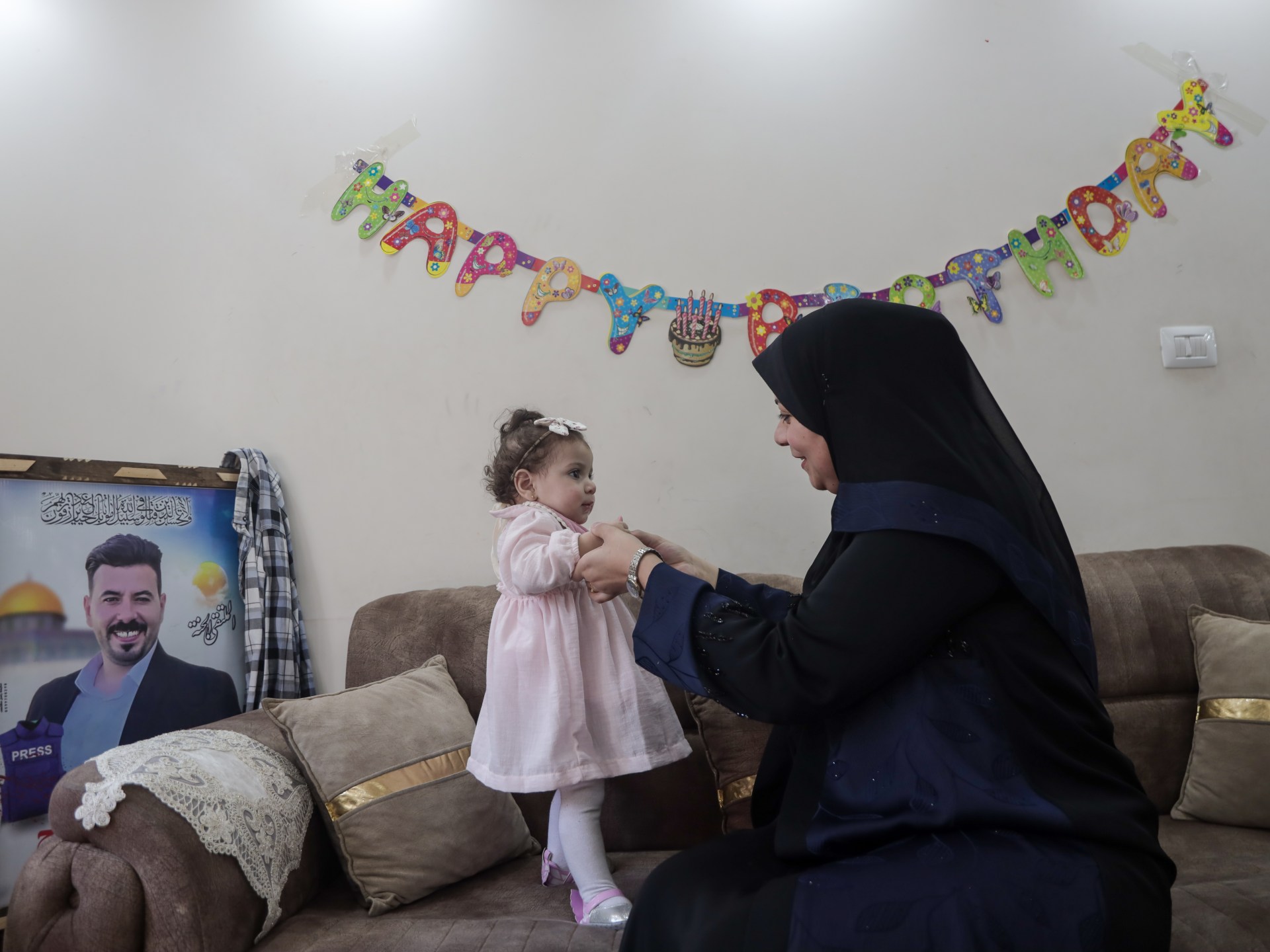
What pains Amal most is thinking about little Sana, who has just turned one, and wondering how she will one day explain to her daughter that the day she was born was also the day she lost her father.
“I always look at my daughter’s face and find something of her father in her … in her features, in her smile, even in the way she comes close to me whenever I cry,” Amal says while holding Sana in her arms. “She hugs me as if she is comforting me.”
“I was very hesitant about celebrating Sana’s birthday today,” she adds, with a birthday cake and a few sweets she prepared in an attempt to bring joy to her children next to her, as well as her late husband’s photo. “But in the end, I decided to move forward, even if it is only something simple.”
“If Yahya were here, he would have celebrated her … Sana carries no blame.”
![The family decided to celebrate Sana’s first birthday despite the deep grief over the loss of the father on the same date [Abdelhakim Abu Riash/Al Jazeera]](https://www.aljazeera.com/wp-content/uploads/2026/05/873A9893-1778120863.jpg?w=770&resize=770%2C513&quality=80)